How to Price a ₹50 or ₹100 Product for Online Selling in India
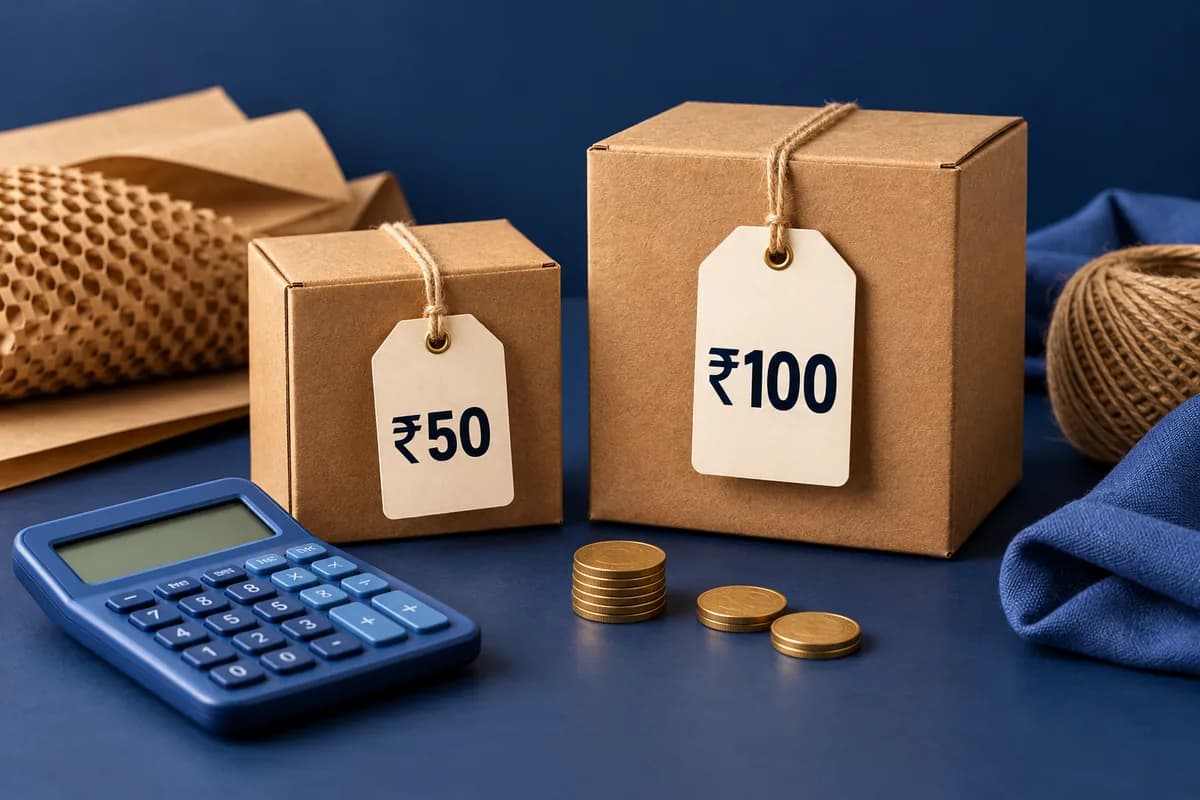
A ₹50 purchase cost does not mean a ₹70 selling price leaves ₹20 profit. Packing, tax, seller charges and return losses can consume that difference. Build a price from the costs you will actually bear, then check whether customers will pay it.
The examples below use the same cost-plus model as SyncTonight's Ecommerce Profit Calculator. They are planning scenarios for online selling in India, not platform tariffs, category tax guidance or a promise that a listing will sell.
Start with a consistent cost sheet
- Record the effective purchase cost per saleable unit. Consider freight into your stock, defects and recoverable purchase GST consistently rather than mixing gross and net costs.
- Add packaging, tape and printing. Use a representative per-order amount when supplies are bought in bulk.
- Enter shipping and marketplace expenses that you actually bear. Separate customer-facing charges from seller deductions.
- Reserve an amount for unrecovered returns and RTO losses. Review it from completed orders, not just a headline return percentage.
- Choose a target profit that can also support costs left outside the model, such as advertising, rent and your time.
Assumptions for both worked examples
Both examples assume 18% output GST, a return allowance equal to 20% of product purchase cost, and ₹0 shipping/other seller fees. Packing is ₹8 for the ₹50 item and ₹12 for the ₹100 item. All are illustrative inputs. The GST rate depends on the product and seller circumstances; zero seller fees must be replaced when charges apply. Separate overheads are excluded.
The return allowance here is a cost reserve, not an assumed 20% customer return rate. For example, ₹50 x 20% reserves ₹10 per order. Actual losses depend on transport, packaging, damage, reimbursements and whether returned stock can be sold again.
Example A: price a ₹50 product
Product ₹50 + packing ₹8 + reserve ₹10 + fees ₹0 gives estimated cost of ₹68. With a ₹20 target profit, the pre-GST subtotal is ₹88. At the illustrative 18% rate, that becomes ₹103.84; the calculator rounds up to ₹104.
| Target profit | Subtotal before GST | Exact price with GST | Rounded price | Profit after GST |
|---|---|---|---|---|
| ₹20 | ₹88.00 | ₹103.84 | ₹104 | ₹20.14 |
| ₹30 | ₹98.00 | ₹115.64 | ₹116 | ₹30.31 |
At ₹104, the GST component is ₹15.86 and the remaining amount after the ₹68 cost estimate is ₹20.14. At a ₹70 tax-inclusive selling price, revenue before GST would be only ₹59.32, leaving an estimated loss of ₹8.68 against those same costs. A visible ₹20 gap above purchase cost is therefore misleading.
Example B: price a ₹100 product
Product ₹100 + packing ₹12 + reserve ₹20 + fees ₹0 gives estimated cost of ₹132. A ₹40 profit target produces a ₹172 pre-GST subtotal, or ₹202.96 with the example GST. The suggested whole-rupee price is ₹203.
| Target profit | Subtotal before GST | Exact price with GST | Rounded price | Profit after GST |
|---|---|---|---|---|
| ₹40 | ₹172.00 | ₹202.96 | ₹203 | ₹40.03 |
| ₹60 | ₹192.00 | ₹226.56 | ₹227 | ₹60.37 |
The small difference between target and estimated profit comes from rounding the selling price upwards. GST is recalculated from that final inclusive price. For example, at ₹203 the tax is 203 x 18 / 118 = ₹30.97; subtracting unrounded tax and ₹132 costs leaves ₹40.03.
This inclusive-tax split follows CBIC CGST Rule 35. It does not calculate eligible input tax credit or determine a product's rate. Use the GST treatment appropriate to your business and avoid charging or subtracting the same tax twice.
Try either example, then change packing, fees, GST and the return allowance to reflect your own orders. The target profit input is in rupees.
Find Your Profitable Selling PriceMarkup and profit margin use different denominators
Ignoring tax and other costs just for this explanation, buying at ₹100 and selling at ₹150 creates ₹50 profit. Markup is 50 / 100 = 50%; margin is 50 / 150 = 33.33%. Adding 30% to cost does not create a 30% margin.
A conventional accounting margin normally uses revenue excluding GST. The calculator displays estimated pocket profit divided by the GST-inclusive recommended price. In the ₹203 example, that displayed margin is 19.72%; using revenue excluding GST would give about 23.27%. Compare figures only when their definitions match.
What if there are shipping or percentage-based fees?
Add the seller-side rupee charge to the fee input. In Example A, adding an illustrative ₹15 fee to the ₹20 target scenario makes estimated costs ₹83, subtotal ₹103 and exact GST-inclusive price ₹121.54, rounded to ₹122. That is a scenario, not a quoted fee for Meesho, Flipkart or Amazon.
For fees calculated as a percentage of price, work out the fee at the candidate price and check it again after repricing. The calculator accepts a fixed rupee fee input and does not automatically solve platform percentage schedules. Include applicable tax on fees consistently with your treatment of recoverable credits.
Check the market without abandoning the cost floor
If similar products sell below your workable price, investigate the purchase cost, bundle quantity, packaging and expected return losses before listing. Lowering the target profit may be a deliberate choice; omitting a real expense only hides the loss. Revisit the calculation after discounts and after enough orders have settled to replace assumptions with evidence.
Related Guides
For the difference between selling price, bank settlement and actual profit, read the Meesho seller profit guide. If printing is part of your packing cost, compare A4 and thermal label workflows.
Found this helpful?
SyncTonight's tools and guides are free and always will be. If this post saved you some debugging time, a coffee goes a long way — no pressure, just appreciated.
☕ Buy me a coffee